


International Museums Day-Heritage sites of Seychelles |19 May 2007
It has been recommended by ICOM that this celebration be held annually on May 18.
However, given that each country has its own specific traditions and conditions, ICOM recommends that members organise their events around that selected date, in the spirit of the motto “Museums are an important means of cultural exchange, enrichment of cultures and development of mutual understanding, cooperation and peace amongst all people.”
This year’s theme, chosen by ICOM is “Museums and Universal Heritage.”
Seychelles is endowed with numerous types of heritage, both tangible and intangible. The intangible heritage includes our languages, folktales, songs, proverbs, myths and legends, literature, dance and other forms of artistic expressions. The tangible heritage varies in types ranging from historical monuments to other built structures as well as cultural landscapes.
Many of Seychelles’ tangible and intangible heritages have the potential to be inscribed either on the World Heritage list or the Unesco’s Proclamation of Masterpieces of Oral and Intangible Heritage for Humanity. Importantly, there are also many of our cultural heritage sites, if well marketed, can make significant contributions to the local communities in which they are located.
Today we will look at some of Seychelles’ heritage sites.
The story behind the La Bastille building
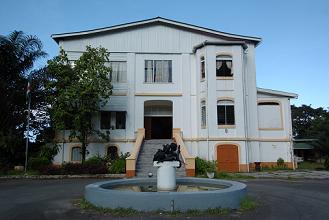
La Bastille, the splendid mansion that stands proudly near the road at Pointe Conan since the mid 1930s is nowadays the site of the National Heritage Research Section (NHRS).
However, the recently painted white and yellow structure holds a fascinating history.
Obviously, its name, La Bastille, was derived from the great French prison fortress of the same name which was destroyed during the French Revolution. However, the similarity ends there. The building, built in the early 1930s by Mr Ange Pilleron, was designed to reflect the great wealth of the Pilleron family. Unfortunately, just a few years after building his home, Mr Pilleron died tragically in 1937.
His daughters, wife and her second husband, Major Moller, continued to inhabit the house until 1948 when it was sold to the government of Seychelles. After remaining vacant for many years and after undergoing major renovations, it was transformed into offices to accommodate numerous government departments, one of the first places to do so in Seychelles.
In 1937, the Survey Division of the Public Works Department occupied some offices in the building, followed by the Ministry of Education in 1975. And before the NHRS, in August 1981, the entire building was occupied by the National Archives of Seychelles.
Grande Case of Silhouette Island
The Grande Case, situated near the La Passe jetty, was built around 1862 by the Dauban family who used to own the island. This vestige of European heritage dominating the small harbor has been renovated over the past years. The roof was replaced by corrugated iron sheets and rotten wooden structures replaced by new ones. As part of the current renovation efforts, the corrugated sheets will be replaced by wooden shingles (bardeaux) to enhance the traditional look. The ground floor will be transformed into a souvenir shop and the upper floor will be converted into a museum housing traditional furniture. Some pieces previously belonging to the Dauban family will also be included to conserve the memories.
Rock Art
There have been many reports about engravings and drawings found on rocks on Mahé and a few other islands. Unfortunately, the locations of most of them have never been revealed because of the belief that they are clues or references to hidden treasure sites.
Indeed, in Seychelles, any engravings or drawings found on rocks are always attributed to hidden pirates’ treasures. This is hardly surprising in view of the historical fact that our part of the Indian Ocean has always been associated with marauding pirates, ruthless buccaneers and corsairs.
Rocks famous for their Rock Art are those on granite boulders at Bel Ombre that bears curious markings and diagrams. These are related to a cryptogram devised by an 18th century pirate named Olivier Le Vasseur (La Buse), apparently rumored to have hidden his massive treasure in that particular area. Indeed quite a few and interesting number of artifacts and items that constitute clues to the treasure have been recovered. They include the stone statue of a woman (Adromeda), rock drawing of a scimitar (a weapon that was used by Perseus), the skeleton of a horse and more.
The Old Anglican Cathedral
The Saint Paul’s Cathedral was constructed in 1857 and consecrated in 1859.Over the years, the cathedral was extended. In 1910 an extension was added on the west side where a new tower was built. It was not until 1970 that new roofing and lighting facilities were installed. The same year another special event occurred where for the first time in Seychelles’ history, a week prayer for the Christian Unity took place with the participation of both Roman Catholic and Anglican worshippers.
In 1963 another special event occurred. Reverend French Chang-Him was ordained the first Seychellois Anglican priest. He was ordained bishop in 1979.
As the old Cathedral was getting smaller for its congregation, in 2002 the Diocese decided to demolish the old cathedral and reconstruct a new one on the same location. The construction work which started in early 2002 was completed in 2004.
Contributed by the National Museums and the National Heritage Research Section