


Island Conservation-The coconut crab |13 March 2006
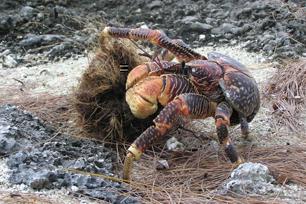
Perhaps they have only previously encountered the husked nuts, as sold in every European supermarket, which readily yield to such treatment. However, cocooned within its fibrous armour plating, the nut is well-protected. The tourist may be beaten but the coconut crab has cracked this problem, quite literally.
Coconut or Robber Crabs today survive across the Indo-Pacific but in Seychelles are only found in the southern atolls. They are most common on Aldabra but can still be found in small numbers on Farquhar. They are land animals, not marine creatures, to the extent that they live their entire adult lives on the land. In fact although they return to the sea to spawn, they cannot swim and would drown within a few hours if immersed in water. They can live up to 60 years, but as they take a long time to mature, they are vulnerable to over-exploitation and have vanished from many islands throughout their range.
This is the world's largest crab with a powerful pincer quite capable of inflicting damage on anything it chooses. Their strong skeleton keeps them safe from predators, except for humans.
They eat almost anything they can find including fruits, vegetation, tortoise and turtle eggs and other crabs. There is even some evidence of cannibalism. But given the opportunity, they love to tuck into a coconut, which unlike the tourist, they have learned how to de-husk.
The process needs time and patience, but the rewards are high and the crab sticks unwearyingly to the task of stripping away the coconut fibre. On Aldabra and Farquhar, evidence of this can be seen outside burrows of the animals, which often have an untidy doormat of material.
It was doubted for a long time that the coconut crab could open coconuts, and in experiments, some have starved to death surrounded by coconuts. However, in the wild, the crab has developed a special technique to do this. It strips the husk always starting from the side with the three germination holes, that little group of three small circles on top of the nut. Once the pores are revealed, the crab will attack one of them until it breaks. Then it uses its smaller pincers to extract the coconut flesh. The main pincers of big crabs can even break the nut into smaller pieces for easier consumption.
A large male Coconut Crab can have a claw-span of up to one metre and has no enemies other than humans. They command respect from other crabs, which will abandon their meal if challenged by a Coconut Crab. Indeed, even rats treat them with a healthy respect. The need to hide their nests from the prying attention of Coconut Crabs may have helped the Aldabra Rail face the modern challenge of introduced predators on Aldabra. These wonderful animals are vulnerable to exploitation and may be endangered but for the present, they are classed as "data deficient" by IUCN, due to a lack of information.
by Adrian Skerrett